A conversation on John 1:1 in Chinese
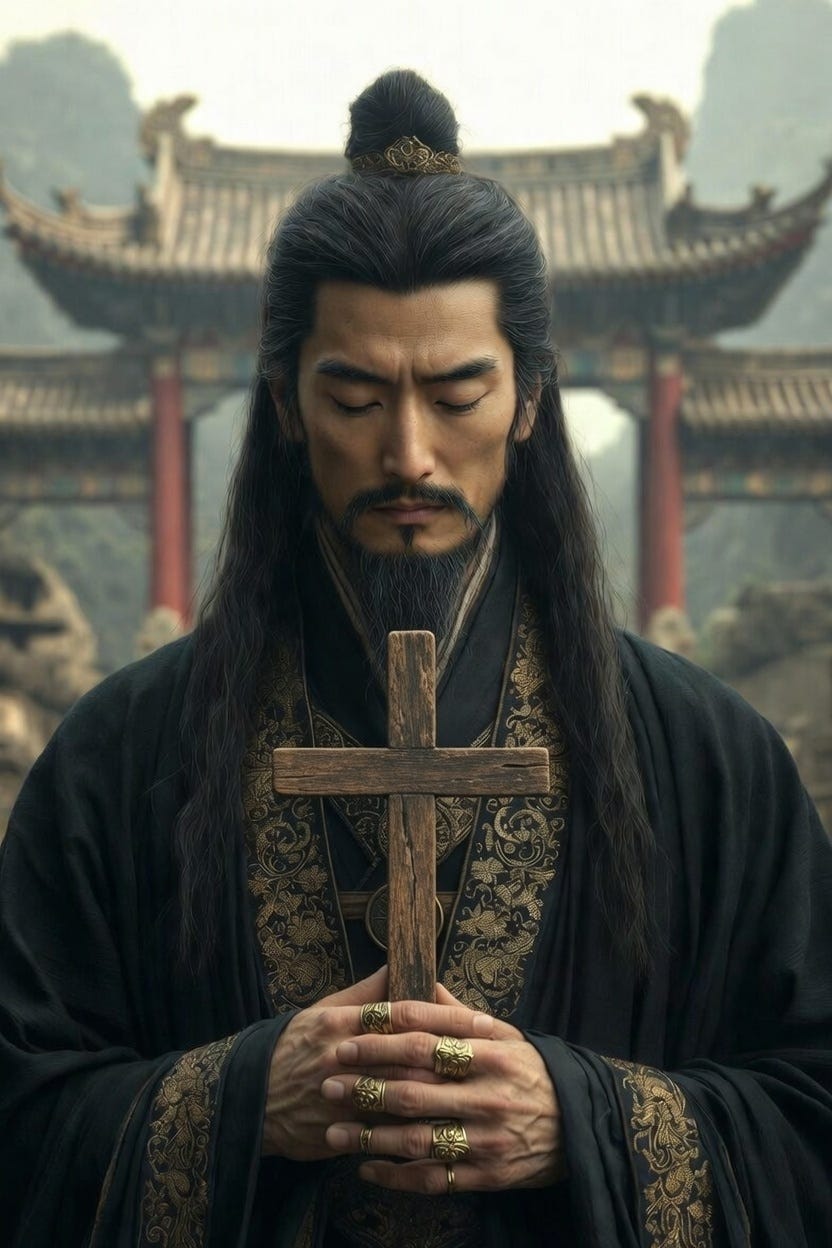
John 1:1 in Chinese reads: 太初有道 — “In the beginning was the Tao.”
The translators chose 道 (dào) — the same word Laozi used twenty-five centuries earlier to name that which is beyond all naming — to render the Greek Logos.
This wasn’t a compromise. It was a bridge built from both sides of the river at once.
Translating the Logos
How do you translate Logos into a language that already has its own word for the deepest principle of existence?
You don’t go around it. You go through it.
A safer translator would have coined a new term. Instead, they planted the Gospel inside the most sacred word in Chinese philosophy and trusted that the truth could hold.
Uniting Chinese and Western Metaphysics
The Tao points toward the ineffable: “The Tao that can be told is not the eternal Tao.” Reality recedes from language. Silence is the truest speech.
The Logos moves in the opposite direction. Logos means word, reason, intelligibility — the self-expression that makes the universe knowable. And John goes further than any Greek philosopher dared: the Logos is not a principle. The Logos is a Person. “The Word became flesh and dwelt among us.”
One tradition says ultimate reality exceeds speech. The other says ultimate reality initiates speech. They seem irreconcilable — but what if they meet at different edges of the same mystery?
The Tao Te Ching knows that ultimate reality overflows every concept we impose on it. Christianity agrees — and then adds something astonishing: that this same ineffable reality chose to speak. Not that the unknowable became small — but that it became near.
The translation whispers to the Chinese reader: what if everything the Tao Te Ching gestures at in its beautiful paradoxes has a name — and that name is a Person?
The Big Irony: The Word Misunderstood
The Gospels are the story of the Word being misunderstood. “He was in the world, and the world was made through him, yet the world did not know him.”
Everyone heard. Few understood.
Read the Gospels closely and you can almost feel the frustration. Jesus tries everything. He speaks in plain language — they don’t get it. He speaks in parables — they don’t get it. He performs miracles — they argue about the Sabbath. He feeds five thousand — they ask for more bread.
At one point He practically spells it out: “If you don’t believe my words, believe the works themselves.” Even that isn’t enough.
The Tao that cannot be told tried every strategy of telling — and was still misunderstood. This is the big irony: the ineffable didn’t stay silent. It spoke, it acted, it healed, it wept. And still we couldn’t receive it. The problem was never on God’s side of the conversation.
I Am the Dao
Now consider what happens when Jesus says, in John 14:6:
“I am the Way.”
In Chinese: 我就是道路。(“I am the Dao.”)
For twenty-five centuries, the Tao was a principle — the nameless mystery behind all things, the reality no mouth could speak. Then the Logos revealed it as a presence: “He was in the world, and the world was made through him.” And now a carpenter from Nazareth stands before His disciples and completes the escalation: the principle is a presence, and the presence is a Person. That’s Me.
The Tao that cannot be told told itself. The ineffable spoke a human name.
For a Chinese reader steeped in Laozi, this claim might land the same way it landed on the Pharisees: as either the most scandalous sentence ever spoken — or the most beautiful.
Walking the Dao
If Jesus is the Dao, then following Him is wu-wei (无为).
Wu-wei is often translated as “non-action,” but that misses the point. It is action in perfect alignment with the structure of reality — no friction, no forcing, no violence against the grain of things.
This is what walking with Jesus looks like. You turn the other cheek — not out of weakness, but because you are moving with the deeper current, not against it. You love your enemy — not because it makes strategic sense, but because it is consonant with the way things actually are. You walk a straight path across complexity, gently, without needing to dominate it.
The Tao Te Ching says: “The Tao does nothing, yet nothing is left undone.” The Gospel says: “My yoke is easy, and my burden is light.” Perhaps they are describing the same experience from opposite banks of the same river.
A Note of Gratitude
And so, a word of thanks to those early missionaries.
They could have translated Logos as 话 (huà) — “word,” flat and literal. They could have kept it safe. Instead they chose 道, and in doing so they made a bold and — I believe — correct claim: that the Tao and the Logos are not rivals. That the deepest intuition of Chinese civilization and the central confession of Christianity point to the same reality.
They trusted the Chinese reader to hear it. And they trusted the Gospel to survive the encounter.
Twenty-five centuries of longing, met by a name.
太初有道。In the beginning was the Tao.