Uma conversa sobre a riqueza da convergência
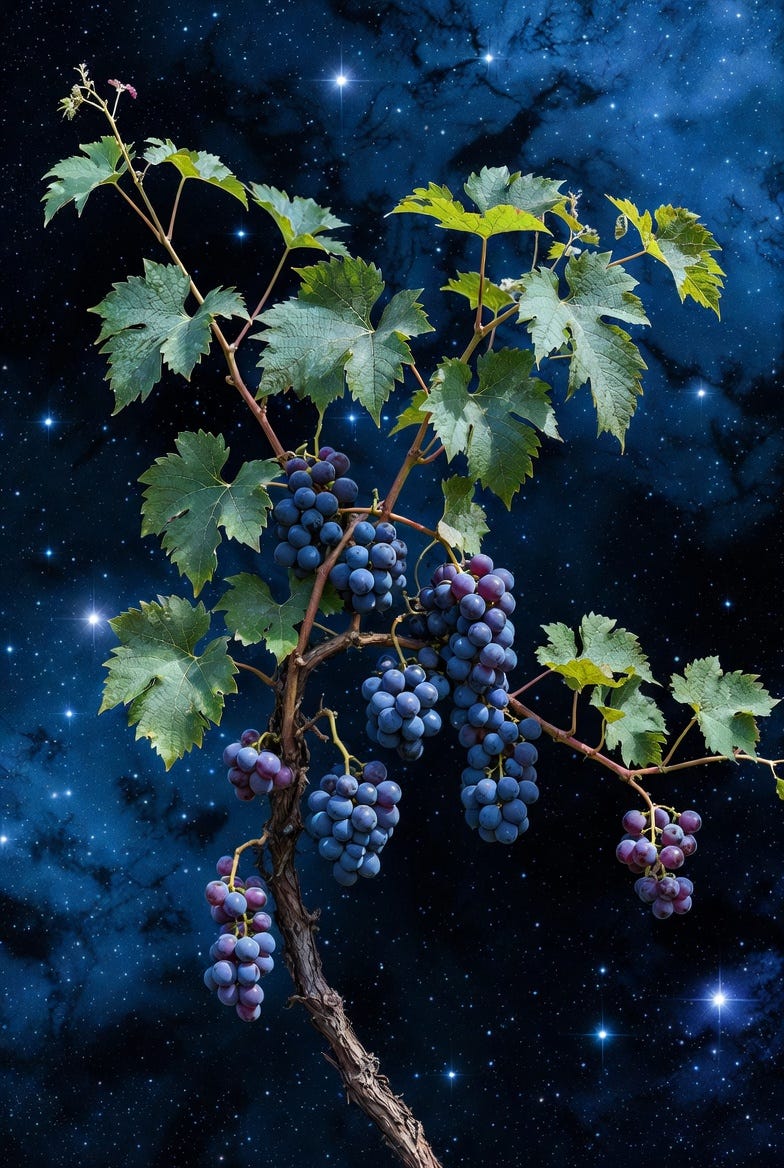
There was a Beginning.
We can calculate approximately when — roughly 13.8 billion years ago. But before there was a number, there was a sentence. “In the beginning, God created the heavens and the earth.”
Thousands of years before anyone could measure it, someone said: everything came from one thing. Not many gods warring. Not chaos sorting itself. One origin. One act. One word. And from that — light, matter, life, consciousness, language, love. All of it, unfolding from a single point.
In 1927, a priest named Georges Lemaître derived mathematically a universe with a beginning — where Genesis was already waiting. Einstein resisted the conclusion. The priest followed the math where it led.
And the chain reaction hasn’t stopped. It had a beginning and it is still happening — stars forming, species adapting, children being born. The creative act is still in motion, and you are inside it. You can participate, which is a gift. Or you can fight it. But you will lose, because you are fighting the current of everything that exists.
I have never recovered from this.
The Awakening
Around 500 BC, on opposite sides of the earth, without contact, the human mind arrived at the same intuition simultaneously. Heraclitus in Ephesus named the Logos — the rational principle beneath all change. Laozi in China named the Tao — the Way that precedes and sustains all things. Confucius began drawing the Junzi — the portrait of the perfect man whose presence alone orders the world around him. Buddha, Zoroaster, each in their own language — the same recognition.
Karl Jaspers called it the Axial Age. I call it the planet waking up.
But the Hebrew prophets had been speaking for centuries already. Isaiah, Jeremiah, Ezekiel. The rest of the world caught up — independently, simultaneously — as if reality itself had been pressing against the human mind from every direction, waiting for enough cracks to form.
The One
Aristotle lived inside a polytheist civilization. Everyone around him worshipped many gods.
And he concluded, through reason alone, that God must be one.
He followed the chain of causes backward and arrived at an unmoved mover — a single, necessary, eternal intelligence from which everything else derives its being. He thought harder than his culture permitted. And what he found, sitting at the end of pure reason, was pointing at the same God Moses had heard from a burning bush.
The Baton
The Logos didn’t stay where Heraclitus left it. It passed from hand to hand across five centuries like a baton in a relay no one had planned.
Socrates asked what the good life required. Plato gave it a metaphysics. Aristotle grounded it in logic and substance. Alexander carried Hellenistic culture to the edges of the known world — including Jerusalem.
And so, by the time a Jewish fisherman sat down to write a Gospel, he wrote it in Greek. And he reached for the word that had been traveling for twenty-five centuries:
Ἐν ἀρχῇ ἦν ὁ λόγος.
John did something no philosopher had dared: he said the principle is a presence, and the presence is a Person. The rational structure of reality looked back at us — and had a face, and hands, and a voice that broke when his friend died.
The baton never touched the ground.
The Mess
The Word made flesh did not come for the philosophers. He came for fishermen who couldn’t keep awake in the garden. A tax collector everyone hated. A zealot. A thief dying on the next cross.
Peter denied him three times. Paul was hunting Christians. The disciples fled at the crucifixion. Thomas wouldn’t believe without touching the wounds. They argued about who was greatest while walking beside the Greatest.
Christianity is, from the very first day, the religion of the lost ones. Not the wise who figured it out. Not the strong who earned it. The people who failed and were found anyway.
I know this because I was one of them. Raised Christian. Couldn’t tell you why it was true. Drifted away — not dramatically, just in the quiet way you drift when you’re holding something you never chose to pick up.
And the relay kept running.
The Cathedral
The church didn’t leave the Logos where John found it.
Augustine absorbed Plato’s line and forged a theology of the interior life — the restless heart that only rests in God. The longing itself is evidence. The ache points somewhere.
A thousand years later, Aquinas received Aristotle back through Arab scholars who had preserved what Europe had forgotten. He built the cathedral of natural theology — demonstrating through reason that God exists, is one, is intelligent, is the source and end of all things. He didn’t claim to prove the Trinity or the Incarnation; those require revelation. But he showed that everything reason can reach points there.
I had no idea this house existed until I walked in.
The Pull
Aquinas also gave us the transcendentals — Truth, Goodness, Beauty, Unity. I think of them as black holes of meaning, the highest-degree nodes in the hypergraph of creation. Their core is transcendent — outside the created universe, outside Spacetime itself. But they organize everything within it with gravitational pull, drawing creation toward them, giving structure to thought, art, ethics, science. They provide contrast, so we can see — the way yin and yang provide contrast, the way light is only visible against darkness.
The transcendentals do not live inside the universe they organize. They precede it. And yet every particular truth, every particular beauty, every particular good — participates in them, the way a wave participates in the ocean.
The Structure
Mathematics amazes me in a way I find difficult to explain to people who haven’t felt it.
Ramsey Theory proves that order is guaranteed in sufficiently large structures. Not likely. Guaranteed. If spacetime is large enough — and it is — then patterns are inevitable. Information is not decoration floating on top of reality. It is the structure.
Fractal theory reveals the same organizing principle operating at multiple levels simultaneously — patterns of patterns, preserving information across scales. The branching of a tree, a river, your lungs. The same logic, repeated, at every magnification.
Category theory formalizes something deeper still: that things can be understood not only by what they are, but by how they relate. Creation is a category. Objects exist, and between them, morphisms — relationships, transformations that preserve structure. When Adam named the animals, he was doing category theory. His first duty was to cultivate and keep — to tend complexity. His second was to name — to categorize. The original human vocation, before the Fall, was steward of complexity and namer of structures.
I was studying the Tao, complexity theory, and category theory simultaneously — and each one helped me understand the others. The Tao taught me to perceive the flow. Complexity theory taught me how new structures emerge from it. Category theory gave me the language to describe what I was perceiving. Three disciplines from three traditions, illuminating each other inside one mind. A small, private Axial Age.
This is what brought me back. Not argument alone. Not experience alone. The convergence — the fact that everything I was studying, from every direction, kept pointing to the same structure, kept rhyming with the truths I had once held and dropped.
The Paradox
The Big Bang was the ultimate divergence — from one point, everything. And not exponentially. Combinatorially. Each new creation doesn’t just add to what exists; it multiplies the space of what becomes possible. Hydrogen meets gravity, gets stars. Stars get heavier elements. Heavier elements get chemistry. Chemistry gets life. Life gets consciousness. Consciousness gets language. Language gets mathematics. The tree branches and branches and branches.
But every branch, examined carefully enough, points back to the trunk.
That is the paradox at the heart of creation: it is divergent in its abundance and convergent in its meaning. Infinite paths, one destination. Like a game of basketball — infinite creative ways to play, but only one basket. And the basket doesn’t limit the game. It creates the game. Remove it and you don’t get more freedom. You get noise.
The transcendentals are the basket. One Truth, one Goodness, one Beauty — and infinite ways to participate in them. The constraint is what generates the richness.
And creation is generous and ruthless. Stars die so heavier elements exist. Species go extinct so others emerge. Ideas fail so better ones take hold. Not despite being ordered, but because it is. Creation and selection, divergence and convergence, in one motion.
The Vine
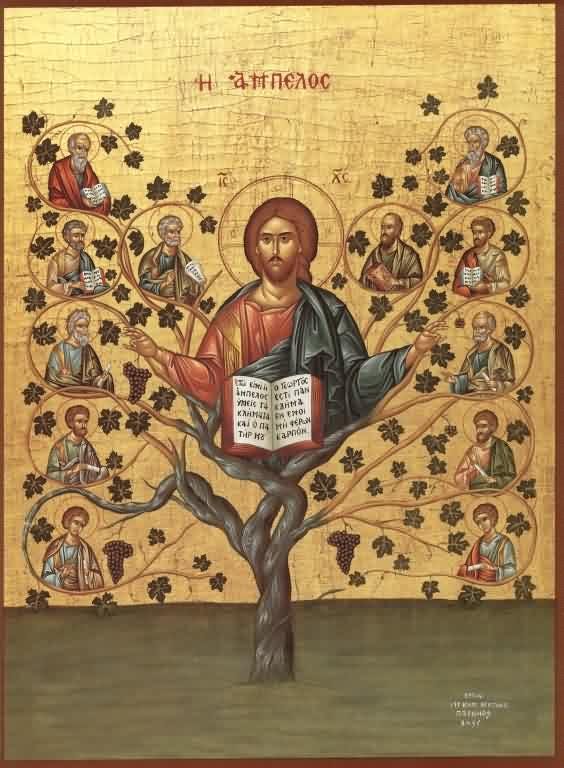
Jesus named this structure before I ever saw it. “I am the vine; you are the branches.” The vine diverges — endlessly, abundantly, each branch free to grow. But every branch draws life from the same root. Cut the connection, and the branch doesn’t become free. It dies. And the gardener prunes — not to diminish, but to channel. Every cut makes the remaining branches more fruitful. Creation and selection are not opposing forces. They are one act, performed by one hand.
Divergent convergence. The richest possible creation, held together by the simplest possible unity.
The Curiosity
Christianity made a claim no other religion made quite the same way: that creation is intelligible because it was spoken into being by an intelligent God.
If the Logos is real, then investigating nature is not impiety. It is worship. To find a law of physics is to read a sentence God wrote. Adam already knew this — his mandate to cultivate and keep presupposes that creation is worth studying, that complexity is worth tending.
And so Christians looked closer. Mendel discovered genetics in his monastery garden. Pascal built a calculator, proved atmospheric pressure, then wrote one of the most penetrating defenses of faith ever composed. Newton pursued the laws of motion as theological inquiry — reading the mind of God in mathematics. And Lemaître followed the math all the way back to the beginning, where Genesis was already waiting.
These were not Christians who happened to be scientists. They were scientists because they were Christians.
The Civilization
That curiosity built a world. Harvard, Oxford — founded on Christian ground. The university as an institution is a Christian invention. So are hospitals built for the poor, legal systems grounded in dignity, the very idea that every human being carries infinite worth.
The civilizational reach is staggering. I can travel to a country whose language I don’t speak, enter a church, and feel at home. The same liturgy, the same Eucharist, from São Paulo to Seoul to Kraków.
I am thankful for my Portuguese brothers who brought Christ to Brazil. For my Italian, Polish, and German brothers who colonized the south, where I live. The faith produced peoples, institutions, cities, sciences, stories — a whole civilization that, for all its sins, rests on the conviction that truth is knowable and persons are sacred.
The Fantasy
The faith produced the greatest fantasy literature ever written. Tolkien — so Christian that his son became a priest — built Middle-earth on the same principles as the Bible: the fall, the long defeat, the eucatastrophe, the return of the King. When I discovered this I was shocked, then I wasn’t. Of course the deepest stories carry the same shape.
The Human Action
Even economics began to amaze me — from a direction I didn’t expect.
Ludwig von Mises started with a single axiom: man acts purposively. From this, by deduction alone — no data, no models, no surveys — he derived value, exchange, price, capital, interest. The entire structure of economic life, reasoned from human nature outward. He called it praxeology. For a Thomist, it feels like coming home: this is natural law applied to economic life.
But what sent me back to Scripture was the question that followed. If Austrian economics describes the natural structure of human action, then what grammar did Jesus choose when He told stories about money?
He tells of a master who distributes capital unequally — “to each according to his ability” — and expects it invested, grown, returned with increase. The servants who double their talents are praised. The one who buries his is condemned. Not for losing money. For refusing to act. He saw the world as dangerous and the master as harsh, and chose the strategy of zero risk — preserve, protect, bury, hide. The judgment is not about the return. It is about the refusal to participate in the creative order.
He tells of a vineyard owner who pays what he freely agreed to pay. When the workers complain: “Did you not agree with me? Am I not allowed to do what I choose with what belongs to me?” Voluntary contract. Private property. Subjective valuation. Three principles in three sentences, deployed without defense, because they needed none.
He tells the rich young ruler to sell his possessions — him, face to face. Not: go to Rome and petition for a wealth tax. Not: the state should confiscate and redistribute. The command is moral, voluntary, individual. And this is the pattern everywhere. In all of Jesus’s teaching — every parable, every sermon, every encounter — He never once appeals to political authority to redistribute wealth. Not once.
This should stop us.
A teacher who understood that anger already participates in murder — that sin begins in the heart before it ever appears in action — would never delegate virtue to a bureaucracy. If charity must come from the heart to count as charity, then charity extracted by force is not charity. It is confiscation wearing charity’s clothing.
Jesus didn’t teach Austrian economics. He taught the Kingdom of God. But the vehicles He chose — unequal distribution, entrepreneurial risk, voluntary contract, private property, individual moral responsibility — were not controversial to His audience. They needed no defense. They were the ground everyone stood on.
Austrian economics claims to describe exactly this ground — not an ideology, but the natural structure of human action. And if the Logos who structured all reality chose to speak in that grammar, then perhaps it is not one economic school among many. Perhaps it is the grammar of creation itself.
The Translation
In the 1850s, missionaries in China faced an impossible question: how do you translate Logos into a language that already has its own word for the deepest principle of existence?
They chose 道. Tao. The most sacred word in Chinese philosophy.
太初有道 — “In the beginning was the Tao.”
It was contested — too loaded, too likely to be misread. The bold ones won. And in a single phrase, twenty-five centuries of Chinese longing met twenty-five centuries of Greek reasoning, inside a Jewish Gospel, in a language neither John nor Heraclitus ever spoke.
The Families
And then — families.
From Taiwan to Brazil. Many of them, spread across different cities, on purpose. They didn’t eat meat — in the most carnivorous country on earth. Some came pregnant. Some husbands came first, alone, and sent for their families once they had a foundation.
Their message was strong enough for all of this.
They didn’t preach the Gospel to me. They practiced the Tao. Their community had a warmth, a discipline, a seriousness about reality that I hadn’t encountered anywhere else. They opened a door I thought was closed. For five years I studied and practiced with them — learning to listen before acting, to align rather than force, to let reality show its structure instead of imposing mine.
I cherish the warmth, the wisdom, and the good people I met. They carried me when I didn’t know I needed carrying.
The Bible
And then I read the Bible.
Not the way I read it as a child — dutifully, without understanding. I read it with eyes trained by everything the journey had given me. The Tao’s patience. Aquinas’s rigor. The mathematics. The warmth of the families. The amazement accumulating for years.
And I was amazed again.
Genesis at the beginning. The prophets thundering through the middle. The Logos at the center — a Person, walking among the lost, eating with them. And everywhere the same pattern: God reaching down, humanity stumbling, grace arriving anyway.
And one recognition that had been forming for years finally became unavoidable.
Confucius spent his life drawing the Junzi — the perfect man who fully embodies benevolence, righteousness, propriety, wisdom, and faithfulness. He described the shape with extraordinary precision. But he never claimed to have met the man.
Jesus, having not sinned, is the Junzi on the limit.
Confucius drew the blueprint. Christ is the building.
Home
Everything on this list amazes me.
That Genesis and the Big Bang converge. That the planet woke up at once. That Aristotle found the One inside a pantheon. That the Logos passed from hand to hand for twenty-five centuries and the baton never touched the ground. That the Word came for the mess, not the merit. That Aquinas built a house deep enough to think in forever. That mathematics reveals the same structure at every scale. That Adam’s first job was to tend complexity and name things. That curiosity became worship. That Tolkien’s imagination could only produce Christian truth. That Jesus spoke in the grammar of voluntary exchange and individual responsibility as if it were the natural order — and perhaps it is. That the faith built a civilization. That missionaries dared to write 道 for Logos. That families left Taiwan for Brazil and carried me home through the Way. That I read the Bible with new eyes and the Junzi resolved into Christ.
That it all fits together amazes me more.
Not because I arranged it — I didn’t build the relay, or write the translation, or send the families, or plant the mathematics in the fabric of reality. I just looked carefully enough, for long enough, and the shape was already there. Waiting. The way it has always been waiting.
Christianity is the only True religion. Not because the others are empty — the Tao carried me home. Not because Laozi and Confucius were wrong — they saw more than they knew. Not because the mathematicians and economists were wasting their time — they were reading sentences God wrote in different languages. But because everything that is true in them arrives here. Every path walked honestly, every question asked sincerely, every longing that refused to settle — they all converge.
Home is home. And when you arrive, you stop walking.
太初有道。